Dayshawn Terry

Software engineerFrontend experienceFull-stack projects

I’m Dayshawn, a software engineer with 5 years of frontend experience turning complex workflows into clear, usable interfaces. I bring that foundation to the full stack.

Open to frontend & full-stack roles · Houston, TX or remote

On the board

Lineform

Independent full-stack development

A sports analytics and research platform that brings schedules, statistics, market odds, and model evaluation into one place.

  • React
  • TypeScript
  • Python
  • FastAPI
  • PostgreSQL
  • Claude API

The live app can take a moment to load. If it’s unavailable, everything on this page still explains how it works.

Read the case study
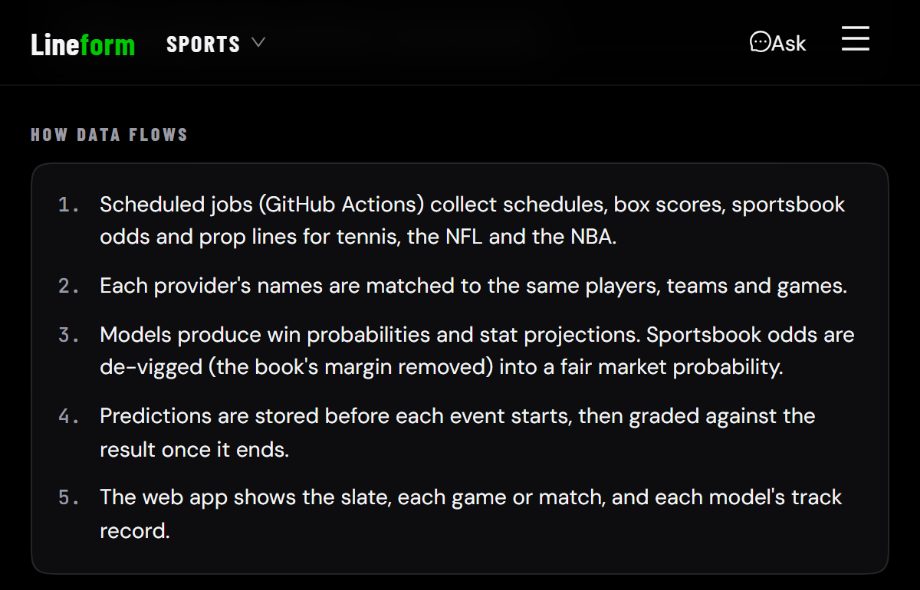
Lineform’s top bar above the How data flows list from its How it works page: scheduled jobs collect data, providers’ names are matched, models produce probabilities, predictions are graded after events, and the web app shows each model’s track record.
How data flows, from Lineform’s public How it works page, November 2026.

How the data moves

Choose a stage

Collect on a schedule.

Seventeen scheduled GitHub Actions jobs gather schedules, box scores, sportsbook odds, and prop lines from 8+ providers for tennis, the NFL, the NBA, and the NHL.

Four decisions behind Lineform

I built Lineform’s frontend, backend, and data workflows. These are a few of the decisions behind the product.

Query performance

An N+1 query pattern was causing endpoint timeouts. I replaced it with batched queries, and moved heavy report builds into scheduled jobs so the API stays within a 512 MB host.

LessonA responsive interface starts with understanding what happens behind the API.

Data quality

I built the FastAPI backend and a 50-migration PostgreSQL schema alongside the React client. Shared player and event identities make providers comparable, and about 5,600 automated tests run in CI.

LessonCollecting data is only the beginning. Keeping it coherent is part of the product.

Model evaluation

I validated every model on held-out seasons, including 12,068 tennis matches, under evaluation rules written before the data was read. The app withholds predictions when the evidence does not support them.

LessonAn honest model track record is more useful than an impressive-looking prediction.

AI assistant

Ask Lineform answers questions about the app’s data in plain English. I wrote its Claude tool loop by hand, and a 30-question evaluation checks that every number in an answer comes from the app’s own data.

LessonAn assistant is only as trustworthy as the data it is allowed to quote.

See how Lineform works (opens in a new tab)

Front Desk Board

Independent project · invented data only

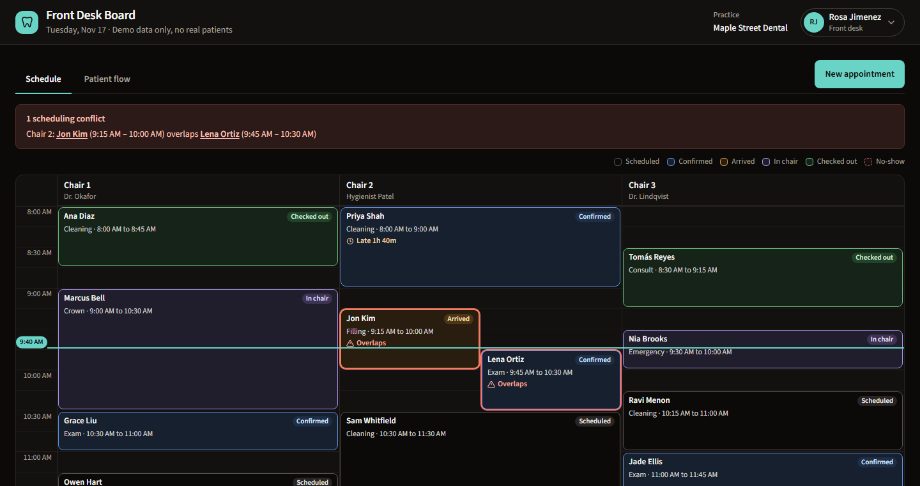
A scheduling board for the front desk of a fictional dental office: chairs as columns, patients moving from check-in to checkout, and double-bookings flagged.

  • React
  • TypeScript
  • TanStack Query
  • Tailwind
  • Claude API
  • Vitest
  • Playwright
Read the case study
Front Desk Board’s schedule in dark mode: chairs as columns, colour-coded visit statuses, a now line at 9:40 AM, and a red banner flagging a double-booking in Chair 2.

Four decisions behind Front Desk Board

Every patient, practice, and provider is invented. These are a few of the decisions behind the app.

Server state

Nearly all of the state is server data, so it lives in the TanStack Query cache with per-practice keys. Mutations refetch, every status change and move can be undone, and the mock API returns a 409 when someone else just took the slot.

LessonMost frontend state is server state. Treat it that way and the UI stays simpler.

Business rules

The status workflow, role permissions, overlap detection, and open-slot finder are pure functions with no React in them, built test-first. Times are the practice’s wall-clock strings, not Date objects, so results never shift with the viewer’s timezone.

LessonRules that live outside the components are easier to test and harder to break.

AI booking assist

Claude turns a typed request into form fields through a server route that keeps the API key off the browser. Picking a time stays deterministic code, a person always books, and an eval measures how accurate the assist is.

LessonLet the model fill in the form. Let code and people make the decisions.

Accessibility

I hand-built the dialog, tabs, and toast instead of using a UI library: dialogs trap and return focus, tabs follow the ARIA pattern, and changes are announced. axe runs on every screen, in both themes, in CI.

LessonAccessibility holds up when it is tested, not only intended.

See how Front Desk Board works (opens in a new tab)

Experience

Enterprise software taught me to think beyond the screen: permissions, performance, edge cases, and the people doing the work.

Figures from my résumé.
YearsSaber modulesReusable componentsAPI endpoints integratedSaber users
VisualutionsFront-end developer2021–263055+230+400+

Visualutions

Front-End Developer

October 2021 – October 2026

Built enterprise React and TypeScript applications for healthcare analytics, compliance, and practice-management workflows.

Full experience
Products I worked on at Visualutions
ProductAreaStack
SaberHealthcare analytics & complianceReact / TypeScript
  • Sole front-end developer, alongside one backend developer, on a 30-module application serving 400+ users across 50 tenants. I owned the front-end architecture, conventions, code-quality standards, and end-to-end and integration tests.
  • Built 55+ reusable UI components and an 18-rule validation framework shared by all 30 modules, and integrated 230+ REST API endpoints behind OIDC single sign-on.
  • Implemented permission-driven navigation for 50+ access controls, live progress updates with SignalR and Redux, and streaming exports so 100K+ row reports download without overloading browser memory.
Dental practice platformUsed by 100+ dental officesReact / Redux Toolkit
  • One of four original front-end developers, joining before launch and gathering requirements directly from customers.
  • Built report pages with shared filter, table, and CSV export components, plus role-based admin pages for users, locations, providers, fee schedules, and insurance plans.
  • Built the UI for three federal UDS clinical measures tables and four-payer coordination of benefits, behind a feature flag.
BeaconPractice managementBlazor / C# / .NET
  • Developed a practice-management module within a 15-contributor solution.
  • Aligned menu visibility with route authorization, added access-behavior tests, and independently implemented a versioned EDI encoder.

About

I’m drawn to the work between complicated systems and the people using them. At Visualutions, that meant reusable interfaces, data-heavy dashboards, and business workflows that needed to work reliably.

In my own projects, I take that care further. Lineform runs through the full stack, from scheduled data jobs and database queries to a React interface and a Claude-powered assistant. Front Desk Board brings my enterprise habits to a frontend scheduling demo: business rules as tested functions, role-based actions, and accessibility checked in CI.

B.A., Computer Investigation and Criminal Justice
St. Ambrose University

Interfaces & interaction

  • React
  • TypeScript
  • JavaScript
  • Next.js
  • Redux Toolkit
  • TanStack Query
  • React Router
  • Blazor
  • Fluent UI
  • HTML & SCSS
  • Chart.js
  • Power BI Embedded

Backend & data

  • Python
  • FastAPI
  • C# / .NET
  • PostgreSQL
  • SQL Server
  • SQLAlchemy
  • Alembic
  • REST APIs
  • SignalR & SSE
  • OAuth 2.0 / OIDC

Cloud & AI

  • Claude API: tool use, streaming, evals
  • Claude Code
  • AWS Lambda
  • API Gateway
  • DynamoDB
  • S3 & CloudFront
  • IAM
  • CloudWatch

Testing & delivery

  • Playwright
  • Vitest
  • React Testing Library
  • Pytest
  • GitHub Actions
  • Azure DevOps
  • Vite
  • Git

Hiring for frontend or full‑stack?

Dayshawn21@gmail.com

I’d be glad to hear about your team and what you’re building.